Pepperell Crafts · Internal report
A complete account of the work behind the migration: a brand-built storefront, a reorganized and enriched catalogue, rebuilt pages, and real defects fixed. Every "before" claim in section 02 was verified against the old site on 28 July 2026; the rest is drawn from the build record.
01 — Summary
The old site ran a generic third-party theme (Athens) over a catalogue organized as 56 loosely related collections. The new build replaces the theme with one designed around the Pepperell brand, reorganizes the catalogue into eight clean categories, gives every product a descriptive title and a structured set of attributes it did not carry, adds pages the old site never had, and fixes defects that were live before launch, including a homepage that scrolled sideways on desktop and phones and a search page that showed no results.
Every published product gets a descriptive title, a structured set of attributes, and one of the eight categories.
A confusing 56-collection menu becomes eight clear categories with a subcategory filter.
An over-width homepage (desktop and phones) and an empty search results page, both measured on the old site.
Category, type, material, brand, skill, and use cases, where the old catalogue carried none.
Nothing about the store's transactional core changes. Orders, customers, checkout, tax, and every sales channel and pixel stay exactly as they are; the catalogue is edited in place so no product loses its identity.
02 — Fixes
Two defects were reproduced and measured on the old site on 28 July 2026, before the switch. Both are the kind a shopper hit on an ordinary visit, and both are resolved in the new build.
On a standard 1,333px desktop window the old homepage was 4,796px wide, so the page could be dragged 3,463px to the right past its own content. The same fault hit phones: at a 500px width the page was 1,500px wide, three times the screen. The cause was a decorative scrolling-text ("marquee") section that was never clipped, combined with the page allowing horizontal scroll (html, body { overflow-x: visible }). The new theme clips overflow at the page edges (overflow-x: clip), so the layout holds at every width.
Searching the old site returned a page whose title read "55 results found for paracord," but the results area was empty: the footer sat directly under the breadcrumb with no products between them. A shopper who searched saw a blank page and assumed the store had nothing. The new theme renders a working results grid with product cards, images, prices, and pagination.
The two defects above are what a shopper hit on the old site. Separately, the new theme was built and checked on real WebKit (iOS Safari's engine) and Chromium at phone and desktop sizes, so its own layout holds where a generic theme can be inconsistent:
03 — Performance
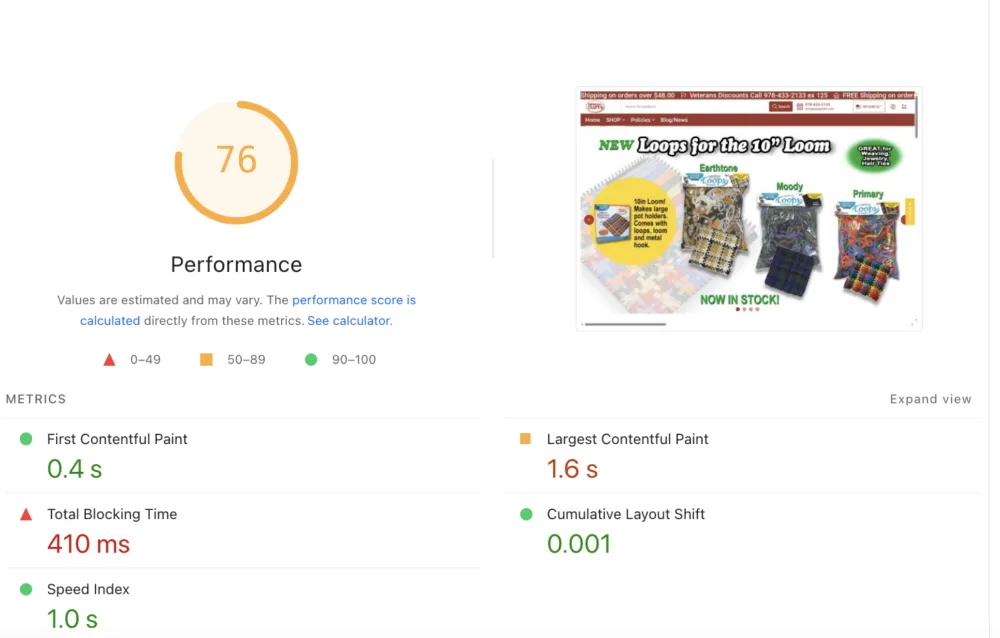
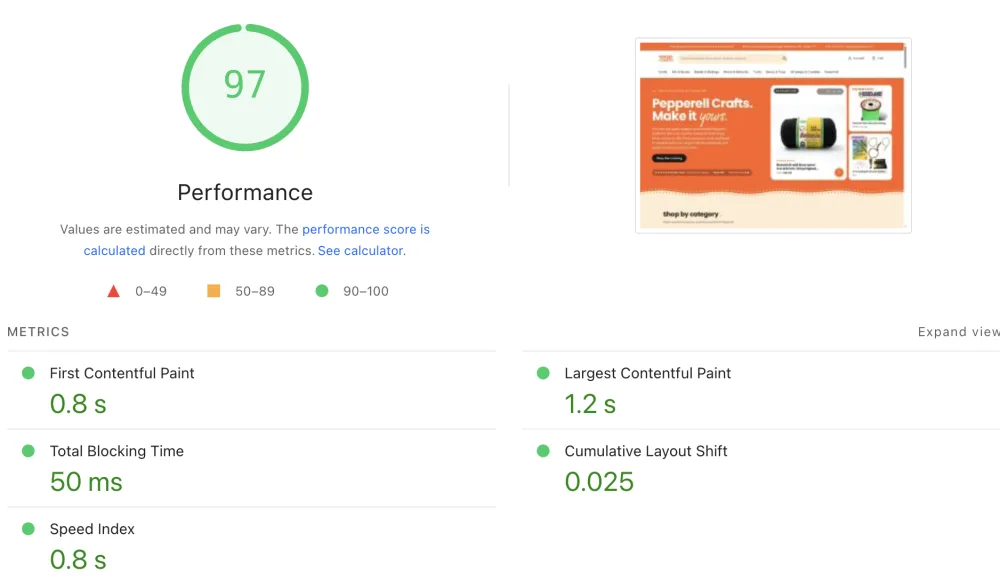
The rebuilt store loads fast and holds its layout while it does. Google Lighthouse scores the new homepage well above the old site on the metrics shoppers and search engines actually feel.
The overall Performance score moves from 76 to 97, driven by a large drop in blocking time (410ms to 50ms) and a faster largest paint (1.6s to 1.2s), with the layout staying stable as the page loads. The gains come from how the theme is built:
srcset, lazy-loaded below the fold, with explicit dimensions so nothing jumps.A few Lighthouse metrics sit outside the theme's control. The Best Practices score and part of the blocking time come from third-party code that Shopify and installed apps (payments, analytics, reviews) add to every store, not from the theme. The metrics the theme owns, and that affect real shoppers and search ranking, are all in the green.
04 — Storefront
The old site used an off-the-shelf theme with off-brand type, colour, and layout. The new theme is built from the Pepperell brand book, so the identity is consistent on every page.
| Element | What the new theme brings |
|---|---|
| Typography | Poppins for headings, Zilla Slab for body, and the self-hosted Market Pro for the script accent, matching the brand pairings rather than the theme's defaults. |
| Colour | The brand palette throughout: main orange, primary dark for hovers, warm cream and lavender for alternate sections, warm taupe for accents, contrast-safe link colours. |
| Section transitions | Hand-built organic "wavy seam" edges between sections in place of hard straight lines, with a consistent renderer so adjacent seams differ and tile with no visible gap at any width. |
| Illustration | Brand doodle watermarks and heritage "polaroid" photos placed as background decoration, with merchant controls to hide them per section. |
| Motion | Subtle, reduced-motion-aware interactions: hero swipe on touch, keyboard and dot navigation, no layout shift on load. |
The theme is also built to be run by the Pepperell team without a developer: roughly 240 settings carry plain-English help text, four craft fields are dropdowns, and a standalone manual documents every screen.
05 — Homepage
The homepage is reorganized around what a craft shopper needs first: what to shop and who the company is.
06 — Navigation
Eight clear categories replace the 56 collections the old site carried, many of them overlapping, seasonal, or internal and impossible for a shopper to make sense of. A subcategory filter sits underneath each category.
| Old site | New build |
|---|---|
| 56 collections, including duplicates, holiday and overstock lists, and internal ones, all reachable from the menu | Eight categories: Cords & Lacing; Kits, Books & Patterns; Beads, Findings & Closures; Wood, Slates & Naturals; Tools & Workshop; Decor, Toys & Finished Pieces; Oil Lamp & Specialty Candle Supplies; Industrial Products |
| No consistent subcategory filter | A Product-type filter (Paracord, Macramé Cord, Kits, and so on) on every category page |
| Menu and footer point at the old, tangled set | Main menu and footer rebuilt to the eight categories, with the current category highlighted |
| Old collection links would break under a reshuffle | Every retired collection URL gets a 301 redirect to its new category, so nothing 404s and search ranking is preserved |
Categories are driven by a single product field (main_category), so membership is automatic and stays correct as the catalogue changes, rather than hand-maintained lists that drift.
07 — Catalogue
Every product gets a descriptive, searchable title in place of the short internal name it carries today, and its description is rewritten in a consistent voice. The rewrite was checked against each product's original data and photos so it stays accurate and adds no claim the source does not support.
"2mm Bonnie Braid 100 yards" becomes "Bonnie Braid Macramé Cord 2mm x 100yd, Polypropylene, 17 Color Options." The URL handle is unchanged and the original title is kept for rollback.
All 272 product descriptions now carry reworked copy in one consistent voice, checked for accuracy against each product's original data and photos.
Structured product data across 28 fields, written from zero, where the old catalogue had none (detail in the next section).
08 — Classification
Beyond names, each product gains a structured set of attributes the old site did not carry. The migration writes 2,580 attribute values across 28 fields, up from zero. Each value was read from the product's own photos and description, and it powers the category pages, the filters, and the spec tables.
| Attribute | What it does |
|---|---|
| Main category | Places the product in one of the eight categories. Every published product carries one (272 of 272). |
| Product type | The subcategory (Paracord, Macramé Cord, Kit, and so on) that drives the storefront filter. |
| Material | A material list drawn from 25 values, holding two to four for genuine multi-material kits (all 272). Each value was checked against the product's photos and description. |
| Brand | Read from packaging evidence: house and licensed brands (Cora's, REXLACE, Ezzzy-Jig, Silkies, and others), on all 272. |
| Skill level | Set only where it is meaningful (kits), so the filter is not polluted by raw materials. |
| Project | The type of project a product is for, such as macramé or friendship bracelets, drawn from a fixed list. It powers search and the Project filter on the category pages (project 236). |
| Audience, country | Structured values used for search, filtering, and the spec table, shown where useful (audience 96, country of origin 199). |
| Use cases | Plain-language "what you can make" for every product (272 of 272), so the material is not the only clue to what it is for. |
| Specifications | Category-appropriate spec fields feed the product spec table: diameter, length, tensile strength, colour count, and pack quantity for cords and beads; wick type, burn rate, and container size for candle supplies; ISBN, author, publisher, and page count for books. |
The classification was done in place on the existing products, so a product keeps its identity and history; nothing was deleted and re-created.
09 — Photography
The migration brings each product's cleanest image to the front. Across dozens of products the primary photo shown on the storefront was updated to the reviewed version from the new catalogue.
This set is still being refined by hand, so the exact count keeps growing.
10 — Product page
The product page is rebuilt to answer a shopper's questions and to reflect the enriched data.
Colour options show named swatches with hover labels; kit styles render as readable text pills.
Every one of the catalogue's colour values maps to a real swatch, including gradients for camo, tie-dye, and rainbow.
Material, size, and the structured attributes render as a clean, metafield-driven table.
Per-product average stars from Judge.me, shown only where reviews exist, with "Be the first to review" otherwise.
Plain-language "what you can make" guidance on every product.
11 — Pages
Static pages were rewritten to the brand voice and, where the site had gaps, created.
| Page | Status | What changes |
|---|---|---|
| About | Rewritten | Rewritten in full: a customer-facing origin story from the 1917 shoelace beginnings, on the new page design. |
| Contact | Rewritten | Brand-styled, with a Veteran's Discount enquiries block. |
| Shipping & Returns | Rewritten | Clear, current policy in plain language. |
| FAQ | Expanded | A fuller set of real questions and answers. |
| Track Order | New | A guest-first order-tracking page the old site did not have. |
| Accessibility | New | A dedicated accessibility statement. |
| Policy pages | Styled | Brand-styled to match the new theme. |
Legacy pages that only the old site had are removed from every menu and link, so they no longer clutter navigation. The two old catalogue pages stay in place, reachable by direct link. The retired email-list and RSS pages now 301-redirect to the homepage and the blog, so their old URLs never dead-end.
12 — Content
The blog is tidied and aligned, and a tutorials hub is in development.
The blog is consolidated to a single clean address (/blogs/blog) on the new design. All 47 existing articles are kept, with redirects so old links keep working.
A dedicated tutorials hub is in development: filterable how-to guides, each tied to the products it uses, planned as the destination for the product-packaging QR code.
13 — Reviews
Customer reviews are brought forward and branded, using the store's existing Judge.me data.
14 — Accessibility
Accessibility is built into the new theme to WCAG 2.2 AA. The measures live in the theme itself:
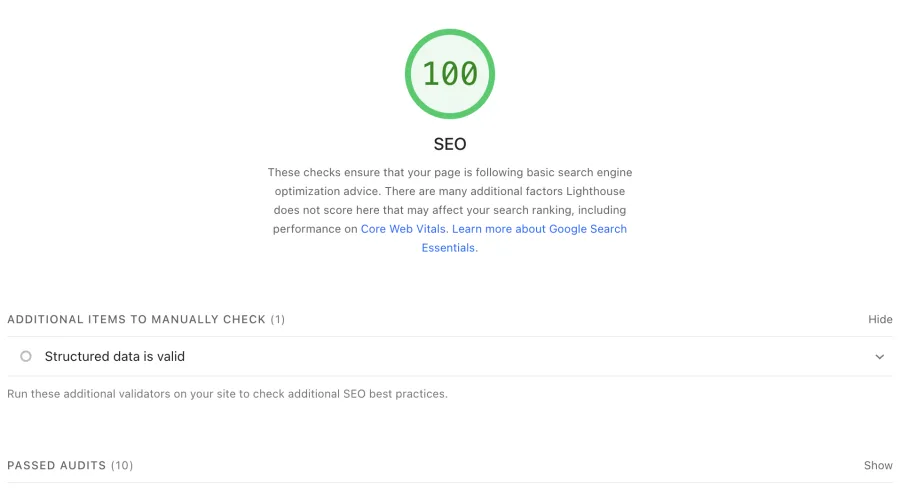
Google Lighthouse scores the new store 97/100 for accessibility.
15 — SEO
The reorganization is structured to protect search ranking.
The full SEO approach, including the sitemap submission and the 301 redirect coverage, is documented in the migration handover guide.
16 — Integrity
Everything above is delivered without putting the running business at risk. The transactional core is never touched, and the change is reversible.
| Preserved as-is | How |
|---|---|
| Orders, customers, checkout, tax | Never read or written by the migration. A theme change cannot affect them. |
| Every app (12), channel, and pixel | All are store-level, not theme-level: Meta, Google, TikTok, Judge.me, Avalara, ShipStation, and the rest stay active. Verified against the live admin. |
| TikTok, Google, and Shop feeds | Products are updated in place, so every product keeps its identity and its feed mapping. No product is deleted and re-created. |
| Reviews and tax data | Store-level app data, untouched; the existing metafields are read, never overwritten. |
| The current look, as a fallback | The present theme stays in the library. Re-publishing it restores the old storefront in one click; catalogue changes revert from a saved snapshot. |
The migration was proven with a read-only dry run against the old site before any change: all 272 published products match one-to-one, so every product is updated in place and none is missed or re-created.